3 months ago
165
3 months ago
165
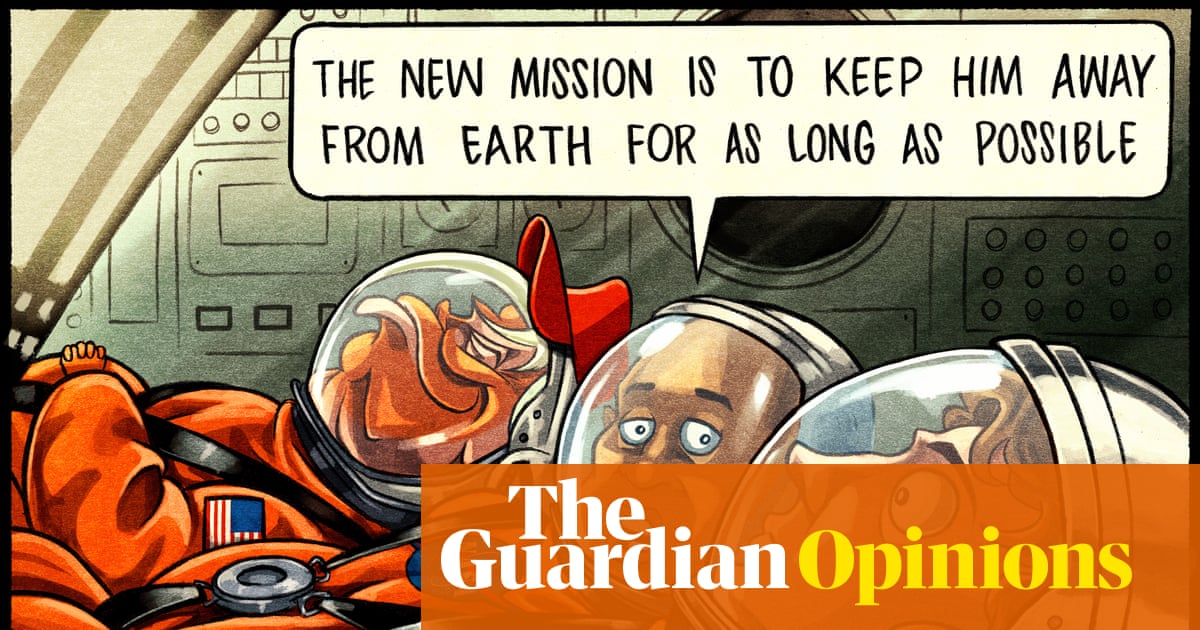
Last week, a Republican senator from my home state of Ohio, Bernie Moreno, introduced the Exclusive Citizenship Act. The proposed legislation would strip me of my American citizenship, because I chose to be French too. Just as Moreno seeks to bully me into choosing citizenship, the US is bullying Europe, trying to force it to pick between total submission to its erstwhile partner, or a break with it.
It is now official US policy that Europe is facing “civilisational erasure”, and that the US will actively support far-right, ethnonationalist, neofascist parties hostile to the EU. Standing by historic alliances is out, protecting Elon Musk and his fellow techno-nihilist broligarchs is in – as is reaping the Kremlin’s praises for it.
What should have been clear as early as November 2024 should, by now, be abundantly so. This version of the US is worse than simply “not our friend”: it is an actively hostile actor seeking to fracture European society in the same way that Russia sought to fracture British society by promoting Brexit, and US society by fuelling disinformation, Maga and Trump. And yet Europe (the UK included) has spent the past year coddling, backtracking, cajoling and capitulating. It has ignored insult after insult from the White House, punitive measure after punitive measure.
Have we not yet had enough of the humiliation?
Two decades ago, the philosophers Jacques Derrida and Jürgen Habermas urged Europe to capitalise on the wave of popular opposition to the Iraq war to produce a new kind of European public sphere with a common sense of shared political fate and future. Only this kind of Europe, the pair argued, would be capable of rising to the challenge of defending cosmopolitanism and the rule of law. The EU is far from perfect, and faces its own internal challenges from far-right authoritarianism. But this is even more true today than it was in 2003: the EU is the sole global actor with superpower potential that remains committed to the rule of law and inclusive, progressive politics.
As a graduate student, I read Derrida and Habermas and felt stung. The US was still under the Obama administration, and at least nominally committed to some type of international order. In hindsight, Derrida and Habermas were prophets of the present. The rift over Iraq that so many thought was temporary has returned as a divide that is structural and probably irreparable.
Some pundits disdain the idea of a more aggressive European response to American interference and coercion. “What is Von der Leyen supposed to do,” they ask: “become a South Park character, and sling insults back at Trump?” To which I could answer: “And so what if she did? What, really, is there to lose?”
Changing Europe’s material reality requires changing the narrative. European leaders have spent the past year negotiating quietly in back channels, hoping that some mix of balance-beam diplomacy and strategic patience will preserve the transatlantic relationship. But, and evidently it needs repeating, this US has made it an official policy to work to end the EU as we know it by publicly supporting far-right parties committed to its destruction.
As the new National Security Strategy states, the US will “cultivate resistance” to the EU from anti-union parties in its member states. The US is also deploying de facto trade sanctions to force the EU to renounce its right to govern its own digital market, treating European regulation of X as barely short of an act of war.
I feel it too, the foundation of humiliation that underpins the politics of anger. I feel it as deeply as any other European, with the added edge that the people who are stealing the deeply flawed, aspirational thing that was supposed to be “America” are also striving to steal it from me as an individual, as a citizen (still) of the US. How do we overcome this, to turn a politics of resentment into a politics of belonging? Not by cowering or grovelling, nor by hoping that some magical US midterms will save us.
The first step towards autonomy is to behave autonomously. That doesn’t need to mean matching Trump’s incoherent-tantrum style of communication; it does mean meeting US hostility with public, rhetorical confrontation that shows Europeans their leaders are not in the business of submission. That they will state plainly that the US far right is an adversary to be countered.
The break is as real as what Derrida and Habermas foresaw, and US attempts to bully Europe into submission also present a door cracked open: an opportunity to build the self-confident narrative that Europe needs to meet this moment. Proposing things like concerted funding of Europe-wide public media, or expanding life-changing schemes like the Erasmus student exchange programme, might seem quaint. In fact, they’re crucial to fostering a shared future and sense of political belonging among European citizens.
When I chose French nationality, I chose European citizenship as well. Not simply a bureaucratic space occupied by technocrats, but a cognitive space. One deep enough for histories to interlock, where it’s OK to be more than one thing at once. That used to be an ideal that the US understood and extolled. Actively renouncing the citizenship I gained by circumstances of birth would mean renouncing people, a place and stories that matter to me. It’s not something I will do. Renouncing the citizenship I chose – and the people, place and stories that I chose along with it – is also something I will not do, and with even more conviction. If the US some day strips me of the former because of the latter, so be it.
-
Alexander Hurst is a Guardian Europe columnist. His memoir, Generation Desperation, will be published in January 2026