3 months ago
169
3 months ago
169
“I would give anything in the world if, in this address, I could say that peace will also come in just a few minutes,” Volodymyr Zelenskyy said in a message to the Ukrainian people released just before midnight on New Year’s Eve. “Unfortunately, I cannot say that yet.”
Zelenskyy said a peace agreement was “90% ready”, but added something that subverted Donald Trump’s constant claims that a deal is just around the corner. “Those 10% contain, in fact, everything,” he said.
It is almost a year since Trump took office and promised to end Russia’s war on Ukraine within 24 hours. That never seemed possible, but as 2025 came to a close a new flurry of US diplomacy began, accompanied by more optimistic statements about peace.

The talks were kicked off by the leaking of a peace plan drafted by Russia and the US. Washington told Zelenskyy that Ukraine would have to give up the Donbas region, while the US army secretary, Dan Driscoll, gathered diplomats from Nato countries in Kyiv for what one person present described as “a nightmare meeting” to tell them Ukraine should sign up to the deal now or face a worse one in future.
Zelenskyy, in concert with his European allies, managed to stave off the plan, which would have felt like a capitulation to most Ukrainians, and started work with the Americans on a new kind of plan. But even if Ukraine and the US are now “90% ready” with that plan, the new year begins with a sense that peace remains elusive. There is little to suggest Russia will jump on board, and however much Trump claims Putin wants peace, Russian officials have made clear they will only sign up to an agreement that deals with what they call the “root causes” of the war.
There is a sense, however, as Ukrainians endure another winter of power cuts, air raids and separated families, that some kind of respite is needed soon. Ukrainians are feeling the exhaustion of close to four years of full-scale war.
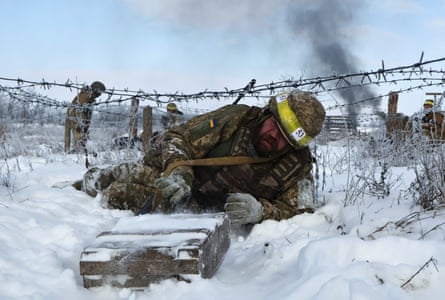
“When I’m at the front I feel OK, but when I come back home I have bad dreams, take antidepressants and so on,” said Serhiy, a Ukrainian soldier who has served on some of the most volatile parts of the frontline, and in December was on home leave in Kyiv. He said he was ready to keep fighting, rather than sign up to something that could prove disastrous for Ukraine in the long run, but conceded he may now be in a minority. “I think by this stage, probably the majority would be ready to go for a bad deal; anything to stop the fighting,” he said.
For many Ukrainians, this new year has been the hardest psychologically since the war began. At the start of 2023 there was still some hope that Ukrainian military success would put Russia on the back foot and lead to something approaching victory. By 2024 this looked much less likely, but some semblance of hope remained.
When 2025 arrived, it was already clear that victory on the battlefield was not imminent, but the election of Trump for a second term boosted hopes in Kyiv that the wildcard politician could benefit Ukraine. An oft-heard prediction in Kyiv a year ago held that when Trump realised Putin was not serious about peace, he would pivot to backing Ukraine fully, disregarding the Biden administration’s red lines and fear of escalation.
That did not happen, and as 2026 begins, it is hard for many in Ukraine to find anything that would give hope of a positive medium-term solution. For now, the best-case scenario appears to be that the Ukrainian military, and society, can continue holding out until the situation in Russia worsens enough that the Kremlin may be forced to accept negotiations on terms that would not require Ukrainian capitulation. The worst-case scenarios do not bear thinking about.
On Friday, Zelenskyy appointed his longstanding military intelligence head, Kyrylo Budanov, to be his chief of staff, after the resignation several weeks ago of Andrii Yermak, his closest advisor, in a corruption scandal.
Budanov, a mercurial and charismatic figure known for planning audacious operations against Russia, has good contacts with western intelligence agencies and also maintains contacts with Russia over prisoner exchanges. His appointment could signal a new approach to security and negotiations from Kyiv.

The coming year may also prove a challenging one for Zelenskyy politically, as the five-year presidential term to which he was elected in spring 2019 nears the seven-year mark.
Martial law in Ukraine prevents the holding of elections, and while there is widespread criticism of Zelenskyy’s leadership on a range of factors, the impossibility of a wartime election is one point on which there is a broad consensus across the Ukrainian political spectrum.
“It would only cause harm,” Serhiy Rakhmanin, an MP from the opposition Holos party, told the Guardian. “He’s the commander-in-chief, and the country is in a position where we don’t have that luxury, whatever issues we might have with him. It would only help the enemy.”
Trump, however, has called for an election, parroting the Russian claim that the lack of elections makes Zelenskyy an illegitimate president. “They haven’t had an election in a long time. You know, they talk about a democracy, but it gets to a point where it’s not a democracy any more.”
Zelenskyy reacted by saying he would ask parliament to arrange the necessary laws to allow for a presidential election in wartime, and asked western allies to explain how they would see the security arrangements for a vote in a country at war. “I don’t want anyone to be able to use the lack of elections as an argument against Ukraine, so I’m reacting to what our partners are saying,” he said.
Valerii Zaluzhnyi, the former commander of Ukraine’s army and current ambassador to London, is widely seen as the most viable electoral challenger to Zelenskyy. Zaluzhnyi has turned down previous offers to join Zelenskyy’s electoral team and is biding his time, having been sold on the idea of a political run but aware of the damage a competitive election could cause to Ukraine’s fragile wartime society.
“He’s not making any active preparations for a campaign, and his public position is that while the war continues he is not thinking about elections and not preparing for them,” said a source close to Zaluzhnyi. “Time will tell whether he goes into politics.”

The year ended with Russia claiming Ukraine had launched a massive drone attack on Putin’s residence, an act it said would be met with a tough response. Moscow provided no evidence to back up the claim, with Kyiv insisting the whole story was fabricated, and the CIA reaching the same conclusion, according to US media outlets. It was a reminder of how easy it would be, even if a ceasefire was agreed around elections or as part of a deal, for Russia to invent a thin pretext to relaunch its war.
Rakhmanin said he thought there were “no objective reasons” for negotiations to be successful while Russia felt it was still advancing its goals on the battlefield, but that there was a small chance of a window for a deal at the end of winter.
“We need three things to come together: more systematic military and financial support from Europe, a stabilisation of the frontline so Russia’s advances stop, and serious economic problems to begin for Russia,” Rakhmanin said. “If these three factors come together, then things can work out, even with Trump’s position as it is. But if even one of them doesn’t work in our favour, then it’s going to be extremely difficult.”