3 months ago
131
3 months ago
131
Once upon a time, long before Wicked became a musical and two movie blockbusters, its composer and lyricist Stephen Schwartz wrote this eccentric picaresque about the restless son of the Holy Roman emperor Charlemagne. Schwartz was 24 when it became a Broadway hit in 1972 but many of the evergreen lyrics reveal an old soul. “Cats fit on the window sill, children fit in the snow,” observes its eponymous hero. “So why do I feel I don’t fit in anywhere I go?”
Pippin’s framing as a musical erected by a band of travelling players fits this fringe venue well. The stage is sparsely decorated and the arriving performers offer a ramshackle narrative conjured from – and constantly on the verge of vanishing into – thin air, thanks to tricks from magic consultant Martin T Hart in a production directed and choreographed by Amanda Noar.
In Roger O Hirson’s book, Pippin is portrayed by a player essaying the role for the first time. Noar heightens the character’s naivety by having the lead actor, Lewis Edgar, plucked as if from the audience, dragooned into the show by the authoritarian Leading Player (Emily Friberg). She casts a spell on him with her brightly painted talons and similarly wields control of a marionette-like ensemble who exude slinky mischief in the opener, Magic to Do.
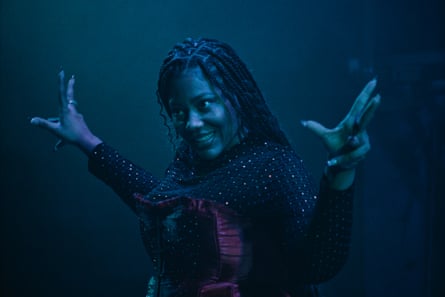
The seductive charm of that song is the keynote of a production that never quite captures the musical’s prevailing malevolence, despite a beguiling performance by Friberg who stalks the stage. The pair of songs about battle, War Is a Science and Glory, should chill in their vaudeville grotesquerie, as should Bob Fosse’s choreography for a routine dubbed “the Manson trio”, referring to the cult leader’s manipulative powers of control.
The Fosse flash – isolated hips, flickering fingers – is often present here but the dark undercurrent of the time in which Pippin was written is mostly missing, despite costume designer Hannah Danson’s blend of the 1970s with AD780. However, counterculture optimism shines through, especially with Simple Joys – performed with hula hoops flying across the stage – and the gentle protest song Morning Glow, richly delivered to its crescendo by Edgar under Simon Jackson’s golden lighting and backed by musical director Harry Style’s industrious five-piece band.
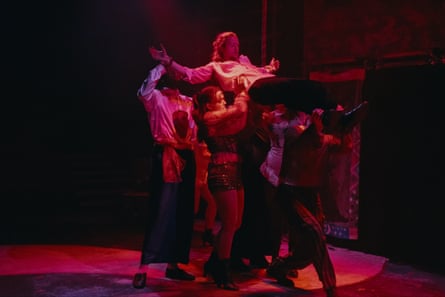
Traditionally, largely due to Hirson’s often leaden book, Pippin can be an annoying and over-earnest hero on his quest for meaning – the character is the major flaw in his own story. But Edgar succeeds in making him more of a rebel against his father (Oliver Wood), even if the overall characterisation remains rather disjointed.
If Pippin is the tale of a boy becoming a man, one of its highlights is grandmother Berthe (Clare Brice) in her rousing solo No Time at All, seemingly growing younger with each line. Elsewhere, Helena Caldas gives us a simpering but sly Fastrada (Pippin’s stepmother) and Mia Quimpo makes a strong professional debut as the antithetically pure Catherine, offering a life stripped of pageantry. There is plenty of weird magic and simple wonder, even if you miss the wickedness.