2 months ago
60
2 months ago
60
OBR chair Richard Hughes says he will resign over budget mistake if Reeves and MPs no longer have confidence in him
Richard Hughes, chair of the Office for Budget Responsibility, has said that he will resign if Rachel Reeves, the chancellor, and MPs say they no longer has confidence in him in the light of the mistaken early release yesterday of its budget report.
Speaking at the Resolution Foundation’s post-budget event, Hughes said:
A link to our EFO (Economic and Fiscal Outlook) document was inadvertently made accessible to the public prior to the conclusion of the chancellor’s statement when it is usually published.
It wasn’t published on our website, but there was a link that somebody managed to find, and that made it accessible, and then it was then disseminated. As soon as it was discovered, we took action to take it down.
We take budget security incredibly seriously, which is why this investigation is already under way and will report very swiftly by early next week.
Personally, I serve day-to-day subject to the confidence of the chancellor and the Treasury committee. If they both conclude, in light of that investigation, they no longer have confidence in me then, of course, I will resign, which is what you do when you’re the chair of something called the Office for Budget Responsibility.
Key events 5m ago OBR chair Richard Hughes says he will resign over budget mistake if Reeves and MPs no longer have confidence in him 8m ago Ask the Guardian your budget questions 17m ago Annual asylum claims up 13% to 111,000, highest figure on record, Home Office says 34m ago Net migration to UK down 69% in year ending June 2025, to 204,000, ONS says 42m ago Getting rid of two-child benefit cap 'huge victory for the left', says John McDonnell 1h ago Reeves dismisses Tory claim that she is raising taxes to fund 'Benefits Street budget' 2h ago Reeves says 60% of families who will benefit from abolition of 2-child benefit cap have parents in work 2h ago Reeves interviewed on Today programme 2h ago 'External person' may have been involved in accidental, early release of OBR's budget reports, says its chair 2h ago Working people would have been better off if Reeves had broken manifesto promise on income tax, thinktank says Show key events only Please turn on JavaScript to use this feature
Ask the Guardian your budget questions
Heather Stewart, the Guardian’s economics editor, and Hilary Osborne, our money and consume editor, will be answering questions from readers about the budget. You can submit one here.
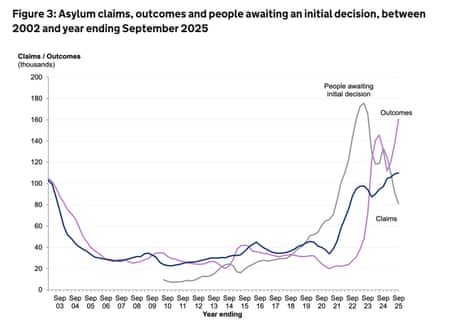
Annual asylum claims up 13% to 111,000, highest figure on record, Home Office says
The Home Office has also published its quarterly immigration-related figures, covering the year ending in September 2025. These show that 111,000 people claimed asylum in the UK in that period, up 13% in the previous year.
The Home Office says this is even higher than the previous recorded peak, which was 103,000 in 2002.
Half of those claiming asylum arrived through illegal routes, such as on small boats. Others arrived in the UK legally, and then claimed asylum.
The figures also show that the number of asylum claimants waiting for a decision has fallen sharply because the number of claims processed has risen by 31%.
Net migration to UK down 69% in year ending June 2025, to 204,000, ONS says
Net migration to the UK was an estimated 204,000 in the 12 months to June 2025, down 69% on the previous year, the Office for National Statistics has said this morning.
The figure, which covers the first year of the Labour government, is the lowest annual figure since 2021, the ONS says in a report.
It says:
At 204,000, long-term international net migration for the year ending (YE) June 2025 was around two-thirds lower than a year earlier (649,000 in YE June 2024). This is similar to the levels we have been seeing since the introduction of the new immigration system, which followed the UK’s leaving the EU. The fall is driven by fewer non-EU+ nationals arriving for work- and study-related reasons and a continued, gradual increase in levels of emigration.
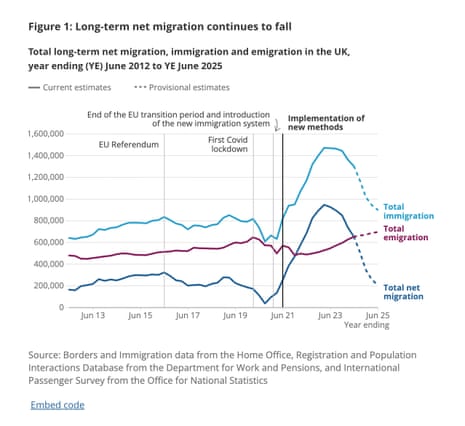
These figures to a large extent reflect the impact of tighter visa regualtions introduced by Rishi Sunak’s government, which have largely been maintained by Labour.
Getting rid of two-child benefit cap 'huge victory for the left', says John McDonnell
John McDonnell, who was shadow chancellor when Jeremy Corbyn was Labour leader, told Sky News this morning that the abolition of the two-child benefit cap in the budget was “a huge victory for the left”.
McDonnell was one of seven Labour MPs suspended from the parliamentary party last year because they voted for an SNP amendment to the king’s speech saying the two-child benefit cap should be abolished.
As Sky News reports, McDonnell said he was not interested in getting an apology from the party for the way he and the other rebels were treated. He said he was “really pleased” by the budget announcement and now wanted to “move on now because there’s a lot more to be done”.
Reeves dismisses Tory claim that she is raising taxes to fund 'Benefits Street budget'
The Conservative party is attacking the budget on the grounds that Rachel Reeves is putting up taxes supposedly to fund more spending on benefit claimants. Even though the rationale for this claim is questionable, the Tories were making it before the budget was announced, and Kemi Badenoch firmed it up last night, claiming it was a “Benefits Street budget”.
On LBC this morning, asked if the budget meant “alarm clock Britain paying for Benefits Street”, Reeves said she did not accept that. She said 60% of the families that would benefit from the removal of the two-child benefit cap (the most expensive welfare announcement in the budget) were in work.
She went on:
I don’t think children should be punished by this pernicious policy any longer. And the cost to society of this is huge, the cost for councils of temporary accommodation, when people can no longer afford the rent, putting families in B&Bs, kids having to move to school all the time because parents have moved from B&B to another lot of temporary accommodation, and there’s costs for years to come, because all the evidence shows that kids that are growing up poor are less likely to get into work and more reliant on the welfare state in the future for them.
So this is a good investment in those kids, to give them the chances that I want for my kids, and everyone wants for their kids. It also saves money for taxpayers on that accommodation, on those additional health costs, and ensuring that those kids grow up to be productive adults.
According to the budget red book, getting rid of the two-child benefit cap will cost £3.2bn a year by 2030-31.
The decision not to go ahead with the planned cuts to Pip (the personal independence payment – a disability benefit) is also in the red book, and that will cost £5.3bn a year by 2030-31, but that decision was taken in the summer.
Robinson finished the interview by asking if Reeves would rule out tax rises in next year’s budget.
Reeves said she would not speculate on that.
Q: The CBI said yesterday the government’s growth mission is stalled.
Reeves does not accept that. She refers to firms that are investing. She refers to JP Morgan opening a new office in London, and she says just today Goldman Sachs has said it is doubling the size of its office in Birmingham, to 1,000 jobs.
Q: Richard Hughes, chair of the OBR, told this programme earlier that none of the measures in the budget are expected by the OBR to increase growth.
Reeves says, individually, none of the measures reach the threshold for the OBR to score them, which would require the OBR to think they could raise growth by 0.1%.
But collectively they will help growth, she says.
Q: Why should people believe you when you say you will cut welfare spending?
Reeves says the budget included measures to cut fraud and waste in the welfare system.
Robinson asks how many more people will pay tax, or the higher rate of tax, because of the income tax freeze.
Reeves says he knows the numbers.
We do. Here is how the IFS explained them yesterday.
Extending the freezes of personal tax thresholds – which were due to end in 2027-28 – for a further three years to 2030–31 is expected to raise £12.7bn per year (in 2030–31), based on current inflation forecasts. The effect of the freeze as a whole – which began in April 2022 – is now forecast to increase the number of taxpayers by 5.2 million and the number of higher rate taxpayers by 4.8 million in 2030-31. However, the actual revenue yield and the number of taxpayers will be determined by inflation, which is uncertain – it could easily be much larger or smaller.
Reeves says 60% of families who will benefit from abolition of 2-child benefit cap have parents in work
Q: Paul Johnson, who used to run the IFS, said yesterday the tax rises were mostly to fund additional spending. But you are protecting people who do not work, because the benefits bill is going.
Reeves says 60% of the families that will benefit from the abolition of the two-child benefit cap have parents who are working.
And poverty creates problems for children. She says, visiting a hospital yesterday, nurses told her children were going to hospital with respiratory illnesses because they were living in cold homes.
Reeves interviewed on Today programme
Rachel Reeves is being interviewed on the Today programme.
Nick Robinson is asking the questions.
He starts by playing the clip from Reeves’s budget speech last year when she said freezing tax thresholds would breach the manifesto.
Q: The OBR said you were £6bn short. But you have raised taxes by £26bn. These are your choices?
Reeves accepts they are her choices.
Q: So it is not the Tories’ fault, or Donald Trump’s fault?
Reeves says her choices are defined by the context she faces. She says under the Tories there were false assumptions about productivity.
Q: You did not tell people the truth about what would be necessary.
Reeves does not accept this. She says she is asking working people to pay more. But she is keeping their contribution to a minimum. And that will come in from 2028. She says she is also cutting energy bills from next year.
Q: During the election every day the thinktanks said the numbers did not add up, and that taxes would have to go up. You denied that. Why won’t you apologise?
Reeves says she has to operate within the forecasts she has been given.
'External person' may have been involved in accidental, early release of OBR's budget reports, says its chair
Richard Hughes, chair of the Office for Budget Responsibility, has said that “an external person” may have been involved in the accidental release of its budget report yesterday.
In an interview on the Today programme, he said that he had written to the chancellor apologising for the fact that the document became public about 40 minutes before she announced the budget – allowing people to learn all the details in advance.
He also said that that Prof Ciaran Martin, the former head of the UK’s National Cyber Security Centre, will be involved in the OBR’s investigation into what happened.
Hughes told Today:
The documents weren’t published on our webpage itself. It appears there was a link that someone was able to access – an external person.
We need to get to the bottom of what exactly happened. We’re going to do a full investigation. There’ll be a full report to parliament.
We’re going to do that work quickly so people can have assurance in our systems and that can be restored.
Working people would have been better off if Reeves had broken manifesto promise on income tax, thinktank says
Good morning. Rachel Reeves, the chancellor, has been speaking to broadcasters and defending her budget. It has not been easy because, although it went down relatively well with Labour MPs and the financial markets (no mean feat – those are two groups whose wishes don’t normally align), it is being hammered by the rightwing papers. Today is the day when the Institute for Fiscal Studies and the Resolution Foundation, the two leading public spending thinktanks, publish their detailed assessments, and they have reservations about some of the budget decisions too.
Reeves has been facing questions about breaking Labour’s manifesto promise on tax, which she insists she has not done. But the Resolution Foundation says would be better off if she had broken it. It explains:
The manifesto tax pledge has cost working people. Having previously hinted at raising income tax rates, the chancellor chose instead to freeze personal tax thresholds for three more years. But raising all rates by 1p would have been less costly than freezing thresholds for anyone with an income below £35,000. Indeed, all but the top 10% of the income distribution are worse off because of opting for threshold freezes over rate rises (which raise similar amounts of revenue).
I will be covering what Reeves has been saying shortly. Graeme Wearden already has some of her lines on his business live blog.
Here is the agenda for the day.
9am: The Resolution Foundation holds a press conference to discuss its budget analysis.
9.30am: The ONS publishes net migration figures for the year end June 2025. And, separately, the Home Office publishes asylum figures for the year ending September 2025.
10.30am: The Institute for Fiscal Studies holds its post-budget briefing.
11.30am: Downing Street holds a lobby briefing.
Morning: Keir Starmer is on a visit in Warwickshire. In the afternoon he is visiting a synagogue in London.
If you want to contact me, please post a message below the line when comments are open (normally between 10am and 3pm at the moment), or message me on social media. I can’t read all the messages BTL, but if you put “Andrew” in a message aimed at me, I am more likely to see it because I search for posts containing that word.
If you want to flag something up urgently, it is best to use social media. You can reach me on Bluesky at @andrewsparrowgdn.bsky.social. The Guardian has given up posting from its official accounts on X, but individual Guardian journalists are there, I still have my account, and if you message me there at @AndrewSparrow, I will see it and respond if necessary.
I find it very helpful when readers point out mistakes, even minor typos. No error is too small to correct. And I find your questions very interesting too. I can’t promise to reply to them all, but I will try to reply to as many as I can, either BTL or sometimes in the blog.