5 hours ago
12
5 hours ago
12
Families with teenagers in education know the private, hidden pain of exam season. But this year, what might have been a summer of quiet family anxiety has erupted in several countries into public unrest.
Exam-related turmoil has led to mass student protests in Mexico after nearly 60,000 university applicants were forced to resit tests amid suspected cheating, while Portugal’s disastrous attempt to digitise school exam marking sparked the country’s worst education crisis in decades.
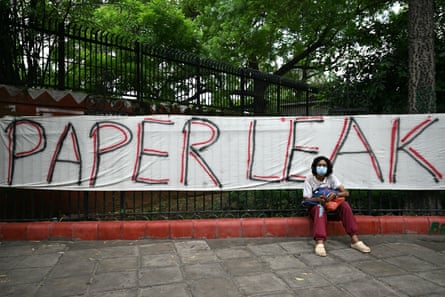
By far the largest and most ground-shaking incident was in India, however, where an exam paper leak affected millions of students and was linked to more than a dozen students taking their own lives. The scandal forced the education minister to resign, and challenged the government’s hold over its 1.4 billion citizens.
Why does this exam season seem to be particularly tense and volatile? Experts say the growth of AI cheating and attempts by academic institutions to digitise examinations are at the heart of the issue. When coupled with the high stakes of good grades in an increasingly precarious global economy, the result can be explosive.
“It would seem that exams are getting more fraught on a global scale,” said Dr Sarah Eaton of the Werklund School of Education at the University of Calgary. “The pressure on young people has absolutely changed.
“We’ve seen the economic situation change around the world in the last decade. And the results of one examination determining a person’s entire future really creates untenable pressure on young people,” said Eaton, a leading expert on academic ethics. “This is a tragedy when young people are dying by suicide because of an examination outcome.”

When a single test can determine a young person’s entire future, cheating is no longer just about individuals but becomes a systematic issue, said Eaton. This is compounded when illicit commercial industries, known as the “education mafia”, exploit student desperation by stealing and then selling exam papers, something that has become widespread in India and elsewhere.
Students from across India joined the mass demonstrations led by the Cockroach Janta party, a youth-led protest campaign that began as an online satirical joke and grew into a nationwide outcry that poses an unprecedented challenge to Narendra Modi’s government.
“When you get large-scale fraud combined with systemic failure, there’s almost a guarantee of a breakdown of public trust,” said Eaton. “And once that trust is broken, it’s almost impossible to regain. I can’t imagine how India is going to deal with this, just given the levels of corruption and fraud that we’ve seen.”

In Portugal, the national fallout from a failed push by its education minister, Fernando Alexandre, to fully digitise the exam marking process has landed the government in a crisis. Parents, teachers, and students have been protesting, demanding Alexandre’s resignation after his policy resulted in serious marking errors.
Similar demonstrations took place in Mexico. The National Autonomous University of Mexico (Unam), the country’s most prestigious university, announced that due to abnormally high marks in entrance exam results, which raised suspicions of widespread cheating, approximately 58,000 students would have to retake the exam.
Schools worldwide are rushing to deal with AI use by students, either through bans or teaching AI literacy and ethics to pupils. Denmark announced this month that from the new term, teenagers would have to make a verbal defence of their written essays to combat AI cheating.
Eaton has implemented similar reforms in her class. “AI can generate a perfect essay in seconds. So an essay is no longer a viable way to demonstrate students’ learning,” she said. “We should let it die with dignity and find other ways to assess student learning.”
In Eaton’s view, cheating is a “human problem” and so grading and assessing student learning has historically also been a human responsibility, which she said cannot easily be off-loaded to the latest tech.
But what institutions around the world have been doing instead, she said, is hoping technology can be easily and cheaply used to prevent cheating en masse.
Dr Thomas Lancaster, a computer scientist at Imperial College London who researches the educational use of generative AI, has studied how cheating has gone hi-tech. It is no longer about sneaking notes written on a sleeve, he said, but sophisticated communication.
Lancaster says students have always cheated but it has become far easier, with pupils using earpieces or miniature cameras, and increasingly, communicating with friends or family with access to internet searches.
“I think the number of notes you sneak in, they’re only useful if they’re the right notes and if you can interpret them very quickly,” he said.
“But with any kind of communication technology, you can have that expertise waiting outside for you in a human form. They either know the answers; they’ve got the expertise; or they can look them up online. You can go further than that now and have access to AI to communicate directly during the exam as well,” he added. “It’s spy technology, really.”
Rather than individual student misconduct, Eaton said the failure to properly train educators was forcing students to spend valuable time trying to navigate through these “broken” systems rather than focusing on learning.
“This idea of these mass examinations happening at scale, it sort of dehumanises the learning process and the assessment process,” she said.
This, she said, “sort of perpetuates this idea that examinations are the most important thing for students. I think we’ve lost the thread. Learning should be the most important thing for students.”