6 hours ago
13
6 hours ago
13
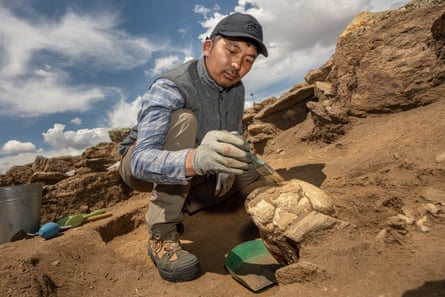
Sodnomjamts Damchaabadgar squats in a shallow, rocky depression, working quietly with his hands. Inches above the rim of the pit, the wind whips across the grasslands. But in the marginal shelter of the dig site the air remains calm – essential for delicate operations.
Damchaabadgar, a research fellow at the Institute of Archaeology at the Mongolian Academy of Sciences, has erected a ger, a traditional nomad’s tent, nearby, which serves as his sleeping quarters and a field station.
-
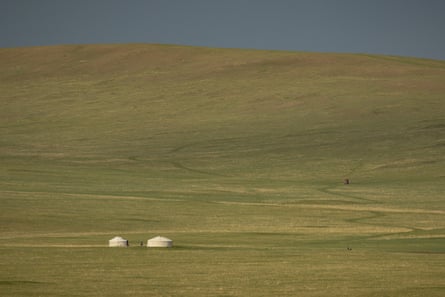
Two gers stand alone against the vast openness of the steppe in Eastern Mongolia. The ger – often called a yurt outside Mongolia – is a round dwelling designed to be assembled or disassembled in a matter of hours
-
Sodnomtsamts Damchaabadgar excavates a pair of skulls from a bronze age burial site in Aduun Chuluun, Töv province
“When we examine these gravesites, we see evidence of horse domestication dating back to the middle bronze age,” he says. “We now think that the ancient peoples of Mongolia may have tamed horses far earlier than previously expected, perhaps as early as 2,000 BCE, which makes sense because horses were critical to survival on the grasslands. They gave an advantage in battle – that’s well known – but perhaps just as importantly, horses gave them the speed that they needed to escape from the grassland’s greatest natural threat: fire.”
-
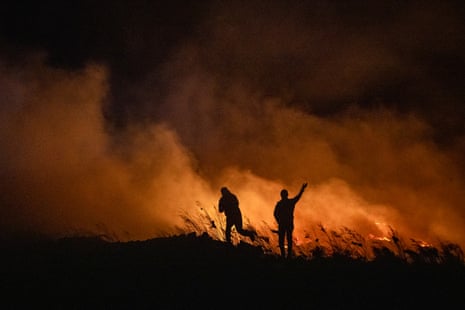
Fire rangers arrive on the scene of a blaze in Bayan-Ovoo, Khentii province
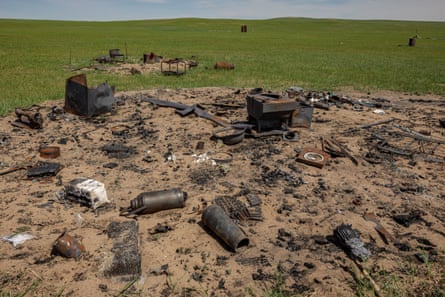
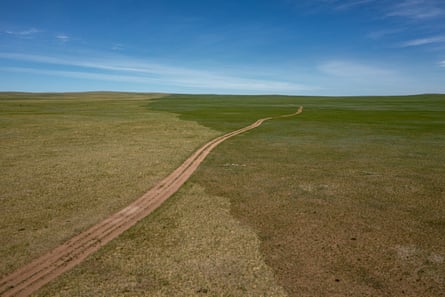
-
Left: the remnants of a burned ger in Dornod province. Right: a faint scar from a recent fire crosses a rural road
While fire has long been endemic on the steppe, the hazard has been steadily growing in the 20th and 21st centuries. The human-driven climate crisis has led to the heating and drying of the Eurasian grasslands, with a 2C rise in temperatures recorded over the last 80 years.
From 1981 to 1995, an average of 1.74 million hectares (4.3m acres) of forest and steppe was scorched each year during fire season. Then, from 1996 to 1999, more than 30m hectares was consumed by fire in four years. More recently, the fire seasons of 2022 and 2025 led to deepening public concern.
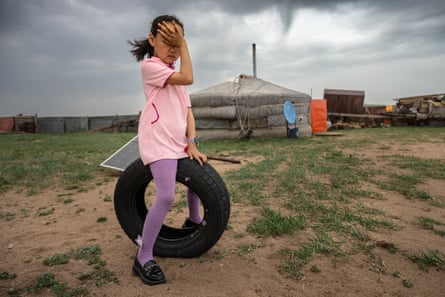
-
Munkhjin, from Bayan-Ovoo, shields her eyes against blowing dust
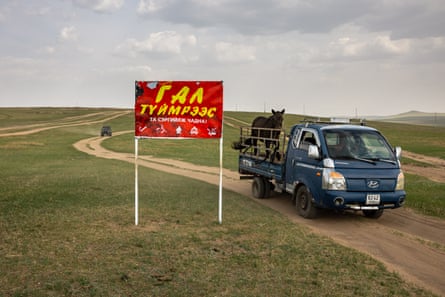
-
A sign in Khentii province reads: ‘You can prevent wildfires!’
According to a recent study about 95% of steppe and forest fires in Mongolia are caused by human activity, whether from careless burning, discarded cigarettes or debris left to smoulder. What starts small rarely stays that way. Most fires move from north to south along prevailing winds, and when a blaze’s speed exceeds people’s ability to move livestock or escape, it becomes a matter of survival rather than containment. For rangers, being first on scene at a fire, however minor its origin, means racing the wind as much as the flames themselves.
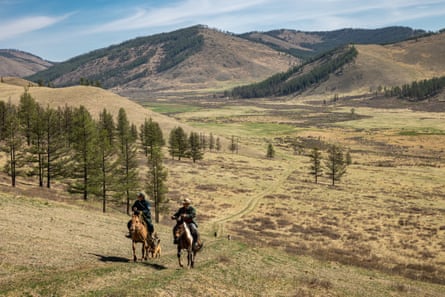
-
Rangers E Munkh-Erdene and T Delgertuul ride through Mungunmorit, in Tôv province
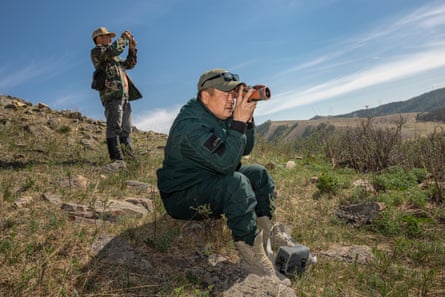
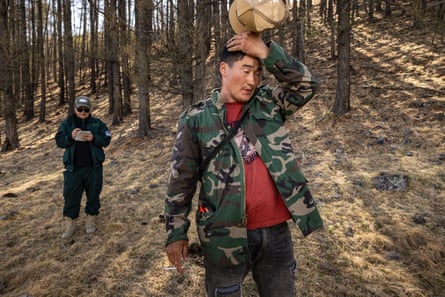
-
Left: Munkh-Erdene, left, and Delgertuul scan the horizon through monoculars in Tôv province. Right: Munkh-Erdene mops his head while examining a recent burn site
The Eurasian steppe is the world’s largest swathe of grassland, extending more than 5,000 miles from Hungary to the western edge of China. The vast, open expanse created a natural land bridge between the continents, a highway of trade and conflict. It was here that the Mongol horse lords built the largest contiguous land empire in world history.
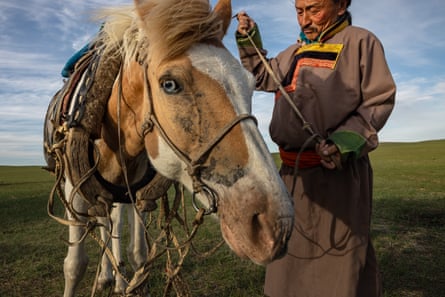
-
Munkhsaikhan, a Buryat herder in Dornod province, carries generations of nomadic knowledge. Below: herders drive a band of wild horses into a temporary corral in Khentii province
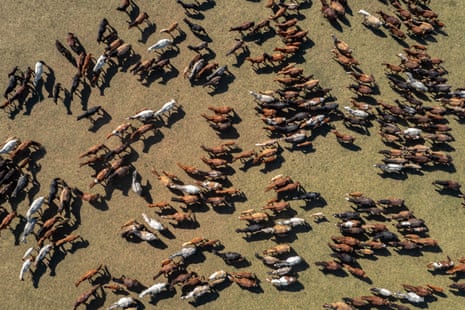
-
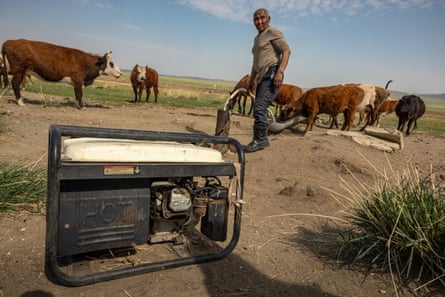
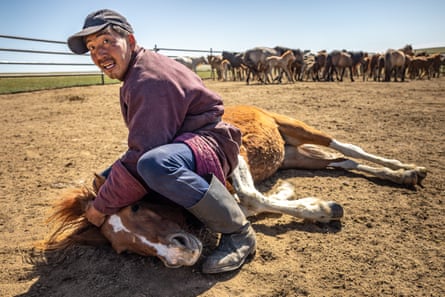
Left: a herder runs a gas-powered pump to draw groundwater for his cattle in Khentii province. Right: Munkhbold Dashnyam, a herder from Bayan-Ovoo, uses a lariat to bring a wild horse to the ground, the first step in the process of ‘breaking in’
“Adaptability was key,” says Erdenesuvd Bayaraa, a cultural heritage expert at the National Centre for Cultural Heritage of Mongolia. “You have to move quickly to survive on the grass. The domestication of horses and a nomadic way of life was the solution. Our ancestors knew how to live on the grass and with fire because they had to.”
-
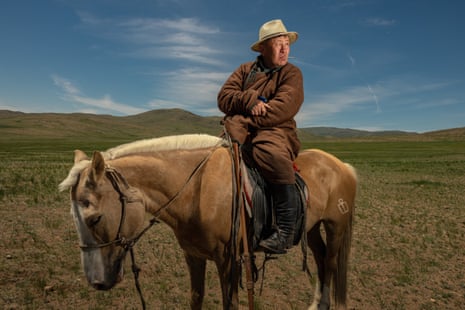
Ranger Choinzon Gan-Erdene sits on his horse after a day of riding
“I believe that the solution lies in our shared heritage,” says Bayaraa. “If we want to live with fire, we have to remember how to embrace it. Today, almost 70% of Mongolians live in cities. But only a few generations ago, it was exactly the opposite. These rural communities had teams of horseback rangers who would be on the lookout for fire.
“When fires occurred, they would ride quickly towards the flames and dig trenches to block the spread. Then they would cut openings for people to pass through and use animal fat to break up the fire line. If we want to stop fires from spreading out of control today, we need to respond the way that our ancestors did. I believe that people on the land are the solution.”
-
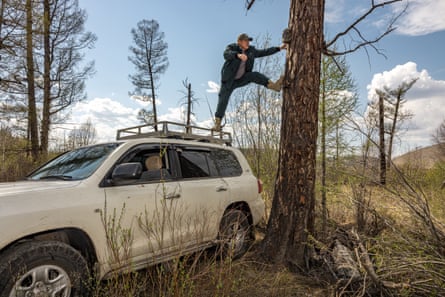
T Delgertuul inspects a motion-activated trail camera. The cameras detect signs of illegal hunting or unauthorised access to a site that remains ecologically sensitive and spiritually significant to the Mongolian people
-
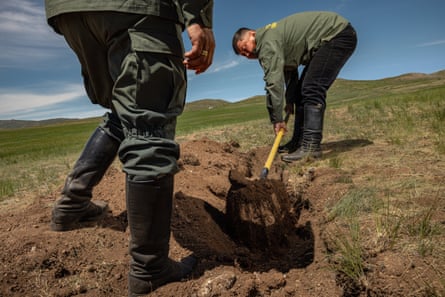
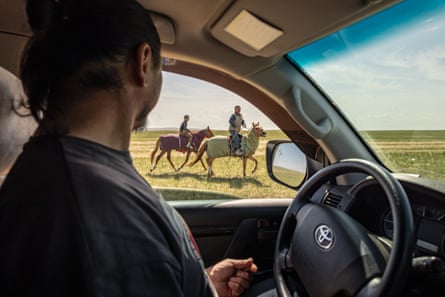
Left: ranger Choinzon Gan-Erdene and a colleague dig a trench by hand, cutting a break in the ground meant to stop a wildfire’s advance before it reaches herders’ campsites and pasture. Right: ranger M Batbaatar stops his truck to ask a group of riders for directions in Khentii province
Bayaraa’s ideas are gaining traction. In 2024, she and other local leaders joined Preserving Legacies, a National Geographic Society-funded global initiative focused on creating climate adaptation solutions that bridge traditional cultural knowledge with emerging technology. Supported in part by the programme, the Mongolian government is strengthening its fire ranger corps, embracing a mix of traditional, horseback fire management techniques coupled with modern technology such as satellite detection and advanced weather modelling. Starlink services, which launched in March 2024, have further enabled communication between the frontline rangers, communities, and smoke jumpers who respond by parachuting behind fire lines.
-
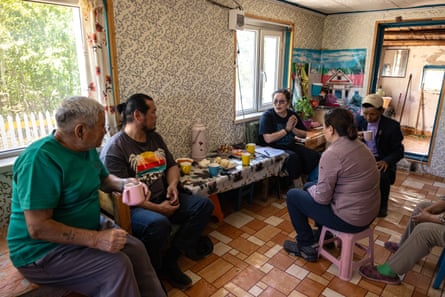
Erdenesuvd Bayaraa and ranger M Batbaatar meet Gombodorj Erdeemuu and his wife in Dornod province
Also in 2024, Mongolia launched a major initiative with the UN Development Programme and the China International Development Cooperation Agency to strengthen wildfire forecasting, reporting systems and fire suppression management. The project has delivered $350,000 (£260,000) worth of firefighting equipment to rangers working with the National Forest Agency and expanded training with fire jumpers from locations such as Alaska. The Mongolian government is also pursuing a variety of incentives to encourage people to remain in rural communities or return to them, including financial packages for those willing to relocate from cities back to the countryside.
-
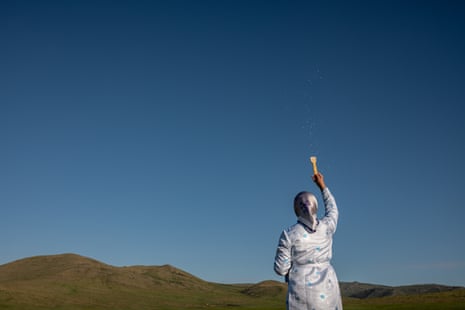
A woman flicks milk skywards during the Öndörkhaan mountain worship ceremony, in Khentii province
“People have known how to survive on the grass for thousands of years,” says Bayaraa. “Remaining here means remembering who we are while continuing to adapt and bring new technology to the table. We can do that. Adaptation is central to our way of life.”