3 months ago
151
3 months ago
151
If you’re an avid viewer of online fitness content (or live below someone who is) you’re probably familiar with TikTok’s 50 jumps challenge. The basic premise is simple: you jump 50 times as soon as you wake up, for 30 days straight. Reach the end of the month and you’re supposedly in for a world of benefits.
The jumps, reassuringly, don’t need to be too extreme. Think gentle bouncing with a soft knee bend, rather than tuck jumps. Some content creators show themselves with arms by their sides, swaying their hips as they go; others have their arms crossed over their chests and maintain a strict up-and-down momentum. Some would find their natural home in a moshpit, others at a dance party. Nobody, yet, seems to have purchased a bedside trampoline.
It’s easy to see how this ritual would wake you up (along with, potentially, your downstairs neighbour). But what of the other purported payoffs? Does the 50-jump challenge really boost circulation, increase bone density, improve lymphatic drainage, boost mood and give you a dewy glow, as many online have claimed? And should we all be starting our days this way, as opposed to lumbering sleepily out of bed in search of coffee?
Is it actually good for you?
Jose Guevara, AKA Shredded Dad, a fitness instructor known for his home gym workout videos, says it’s not an entirely unreasonable challenge. “Jumping lightly gets circulation going and warms up connective tissue and muscles that might feel stiff after sleep,” he points out. “While the exact mechanism is uncertain, one reliable outcome is that people report feeling more alert and energised.”
As any early morning exerciser can testify, there is nothing like a spot of movement to dispel your grogginess. The beauty of the jumping challenge is its accessibility: you probably have time for 50 jumps, even if you don’t have the time or inclination to squeeze in a pre-dawn CrossFit class.

And if you’re only going to exercise for a minute or so, jumping seems to give you a lot of bang for your buck. Eloise Skinner, a fitness instructor and psychotherapist, says it involves a potent mix of strength, endurance and muscular engagement. “It’s great work for the muscles of the leg; it’s good for core engagement when performed with correct alignment; it’s good for improving joint mobility,” she says. “High-energy movement can also be good for supporting metabolic function.”
Performed consistently, the challenge might also lead to improvements in bone health. When we jump, we load the skeleton with an impact force equivalent to around three times our body weight (though that varies a lot depending on the type of jump). This stimulates the osteoblasts (bone cells) to build more bone. “The repeated low-level impacts seem to remind the bones in our legs and hips why they should stay dense,” says Guevara.
A recent scientific paper, which reviewed 18 different studies, found that six months of jump training was associated with a 1.26% improvement in bone mineral density at the hip. That might not sound like a lot, and it’s unlikely that many people have been inspired to do the jumping challenge because they want to build marginally denser hip bones. That said, with almost half of 80-year-old women suffering from osteoporosis, anything we can do to mitigate bone loss is a great thing for our future health.
As for the claim, ubiquitous on social media, that the challenge will give you better skin? Well, this is true in the sense that exercise increases blood flow, which in turn means more oxygen and nutrients are delivered to skin cells. It also helps improve lymphatic drainage (the body’s waste management system for the fluid that builds up in your tissues), which might have some benefits for skin appearance.
“There’s limited scientific research on jumping specifically for lymphatic drainage, but exercise and gentle movement are known to support lymphatic flow and it’s often linked to reducing feelings of heaviness, bloating and puffiness,” says Lannay Dale-Tooze, a personal trainer at Gymshark who has been doing the challenge herself. “From my experience, low-impact hopping feels like a simple way to wake up the body and encourage circulation first thing in the morning.”
What are the potential downsides?
So should we all be jumping (groan) on this trend? Maybe not, suggests Aisling Freir, head of women’s health and a specialist pelvic MSK physiotherapist at PureSportsMedicine. Those impact forces are transmitted not just through our bones, but also through our pelvic floor. For some people, this can lead to symptoms such as leaking urine or a feeling of heaviness in the area.
“We’re not in the business of scaremongering or telling women to stop jumping,” she says. “However, if you’re experiencing pelvic symptoms, jumping should be done with guidance from a trained pelvic health physiotherapist. Pelvic floor issues are often associated with the postnatal, perimenopausal and menopausal stages, but they can affect women of all ages.”
In fact, a 2023 RCOG survey of 2,000 women found that 60% had experienced at least one symptom of poor pelvic health (it’s rarer in men, but still possible). Freir recommends seeing a healthcare professional if you have clear signs of dysfunction. In the meantime, you could attempt a modified version of the jumping challenge, by standing tall with your feet together and arms reaching up; rising on to your tiptoes; then dropping your heels to the floor and softening into a position just above a chair pose.
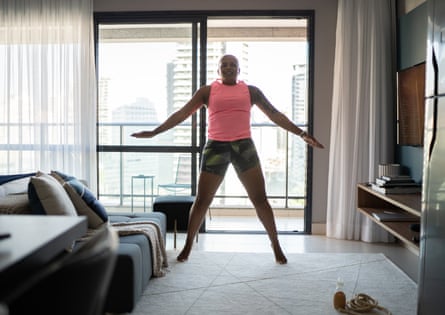
“You could also start with 10 jumps instead of 50,” says Freir. “Monitor symptoms during the activity, later that day, and the following morning. If you remain symptom-free, impact can gradually be increased over time.”
Aside from pelvic floor issues, there are a few other reasons why you might want to apply a note of caution. “If the jumps are performed on a hard floor, there could be quite a lot of pressure on the joints,” says Skinner. “If performed with poor alignment, it could result in injuries, especially around the ankle, foot, knee, hip or lower back. There’s a risk of not warming up thoroughly since it’s often done casually at home. It also could start to become a bit boring, once the trend wears off – depending on how the individual feels, of course!”
An obvious but important point is to make sure you’re jumping in a clear area. Potential slips and falls are no joke – which is not to mention the blinding agony of jumping on a child’s misplaced Lego brick. (Reader, I have experienced it.)
Why do we love a fitness trend?
The jumping trend does have payoffs, especially if you succeed in doing it for 30 days and beyond. In Guevara’s words, “this is no TikTok gobbledegook”. However, it isn’t some magical elixir. Most of the benefits would apply to any form of movement done consistently: we now know that “exercise snacks”, or short bursts of physical activity, can have a measurable impact on cardiorespiratory fitness, even if you don’t have time to fit in a full workout.
It raises the question: why are so many of us drawn to challenges of this nature, when taking the stairs instead of the lift or running for the bus would probably be just as good for us?
With her psychotherapist hat on, Skinner believes there’s a lot of power in social influence and belonging. “If we see many people doing something, we might feel compelled to follow or try it out for ourselves,” she notes. “The dopamine we get from likes and engagement might encourage us to keep following the trend, on top of the dopamine from a new fitness habit.”
As dopamine-fuelled online trends go, it’s clearly a benign one. Just spare a thought for your downstairs neighbour before you progress to advanced plyometrics.
Do you have an opinion on the issues raised in this article? If you would like to submit a response of up to 300 words by email to be considered for publication in our letters section, please click here.