5 hours ago
9
5 hours ago
9
One of the most important collections of UK Jurassic fossils ever compiled has been sold to a museum in Abu Dhabi, the Guardian can reveal, in what British experts have described as a loss for the nation.
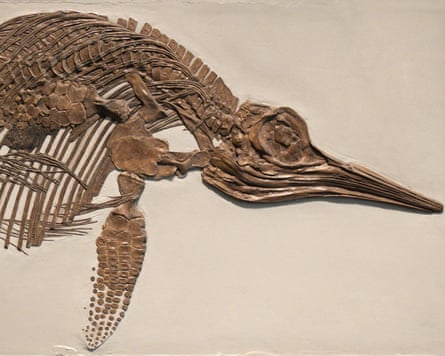
The collection, which was amassed by a private fossil collector, consisted of 318 specimens, including ichthyosaurs, fish and crustaceans among other creatures, some of which could be new species.
The fossils were initially offered for purchase to the Natural History Museum (NHM) in London and to Amgueddfa Cymru (Museum Wales) for what was described by one source as an “eight-figure sum”.
Neither institution bought the collection, with both citing a lack of funding. An email seen by the Guardian suggested the NHM had “no money at all” for acquisitions.
One curator said that while there had long been a hope that the collection could be kept in the UK, it also posed issues around storage space, curatorial time and packaging materials.
“I don’t blame the collectors at all. That’s all they can do. They can’t sit on these things forever,” the curator said, adding that the issue was expected to occur again and again as collectors get older and look for a suitable home for their life’s work.
“Whose responsibility is it to fund our heritage and the preservation of our heritage? Because otherwise it could get lost,” they added.
The extensive collection is understood to come from a sequence of rocks known as the Lower Lias, from Lyme Regis, Charmouth, and the south-west of the UK.
It was compiled by Chris Moore, a private Dorset-based collector with experience of hunting fossils in the area. In emails seen by the Guardian the collection is described as “stunning”.
Some countries, including Mongolia and Brazil, consider all fossils found in those countries in recent decades to be property of the state – a situation that has led to international disputes over repatriation of fossils housed abroad. However, this is not the case in the UK.
Richard Butler, a professor of palaebiology at the University of Birmingham who was not involved in the sale, said the collection was of national significance. “This is one of the most important collections of fossils ever made on the world-famous Jurassic Coast of Dorset. It would have been wonderful to see these fossils on display and engaging the public in a UK museum.”
He added: “This sale raises important questions about whether more should be done to preserve important and irreplaceable natural heritage such as this for the benefit of the UK public.”
In the United Arab Emirates, the Natural History Museum Abu Dhabi confirmed it had bought a collection from Moore, which went on display in November 2025. A spokesperson for the museum said the Lower Jurassic rocks of the UK preserved some of the best examples of marine life from when what is now the Dorset coast was roughly at the same latitude as north Africa.
“All natural history museums around the world tell this story, often using fossils from multiple countries to help narrate their journey through time. If we are to tell a 4.2bn-year story of the evolution of life on Earth, all museums must travel both spatially and temporally with their collections,” the spokesperson said.
“A large majority of the Chris Moore collection is already on public display in the Natural History Museum Abu Dhabi in the Mesozoic Gallery (Age of Dinosaurs Gallery).”
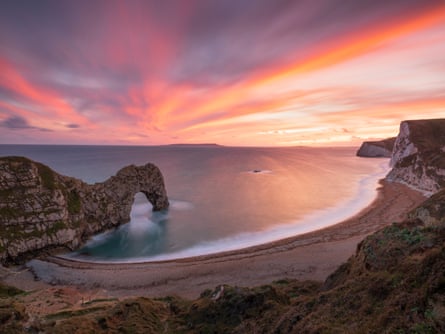
Lyme Regis is part of the Jurassic Coast, a Unesco world heritage site, that is rich with fossils that date back to between 200m and 145m years ago. The area has a long history of private fossil collecting, with notable figures including Mary Anning – a pioneering palaeontologist and fossil dealer whose triumphs included the discovery of the first complete skeleton of a plesiosaurus in 1823.
While approaches vary across the UK nations, modern fossil collectors along England’s Jurassic Coast are encouraged to follow the west Dorset fossil collecting code and the Undercliffs national nature reserve fossil collecting code.
Fossils initially belong to the owner of the land on which they are found, legal ownership is typical transferred to collectors who adhere to such codes and recording schemes – a situation that reflects the valuable role collectors are deemed to have in finding fossils that might otherwise never be recovered.
But while highly valuable archeological finds turned up by activities such as metal detecting can be classified as treasure – and therefore must be reported to the relevant authorities within 14 days of discovery – the same is not true for fossils, even those deemed to be key scientifically important fossils, known as category 1.
According to the west Dorset fossil collecting code of conduct, collectors “who intend to sell or otherwise dispose of their category 1 specimens must first offer them to UK registered museums for a period of six months. If no purchase has been agreed by this time, the collector will be free to offer the specimen elsewhere.”
However, such codes are not legally binding and even if followed, as Moore did, fossils found in the UK can be sold by collectors to private individuals, museums or other buyers – including those overseas. Moore was approached for comment.
According to the Department for Digital, Culture, Media and Sport (DDCMS), only objects that are over 50 years old and are manufactured or produced require an individual cultural property export licence, and there are no export requirements specific to the sale of fossils.
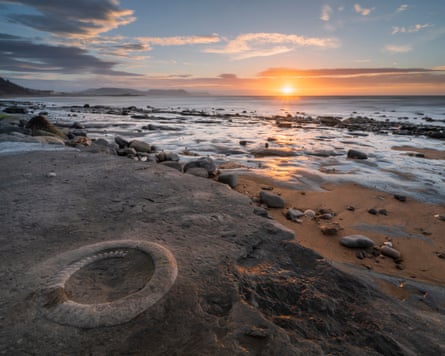
A quick search of online marketplaces reveals a plethora of fossils, with small ammonites selling for as little as a few pounds.
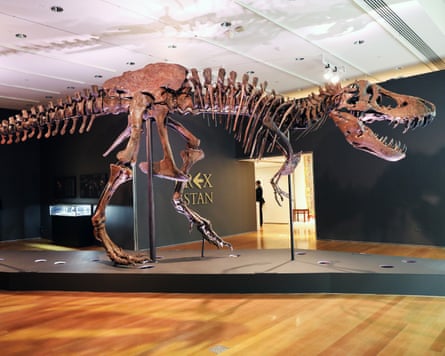
But some fossils can also fetch colossal sums: in 2020, Stan the T rex, now also housed at the Natural History Museum Abu Dhabi, was sold for a then record-breaking $31.8m (£23.6m), while in July this year another T rex skeleton nicknamed Gus was sold at Sotheby’s for $50.1m.
These figures are far beyond the budget of most museums, with such specimens instead snapped up by private buyers – including business people and celebrities. Among those known to have bought dinosaur fossils are the actors Leonardo DiCaprio, Nicolas Cage and Russell Crowe – although Cage later returned the rare dinosaur skull he had bought to Mongolia, after it emerged it had been illegally removed from the country.
Fossils have also become popular on social media, with hunters using platforms such as TikTok to share videos of themselves cracking open rocks in a “fossil or no fossil?” reveal. Some accounts have several million followers.
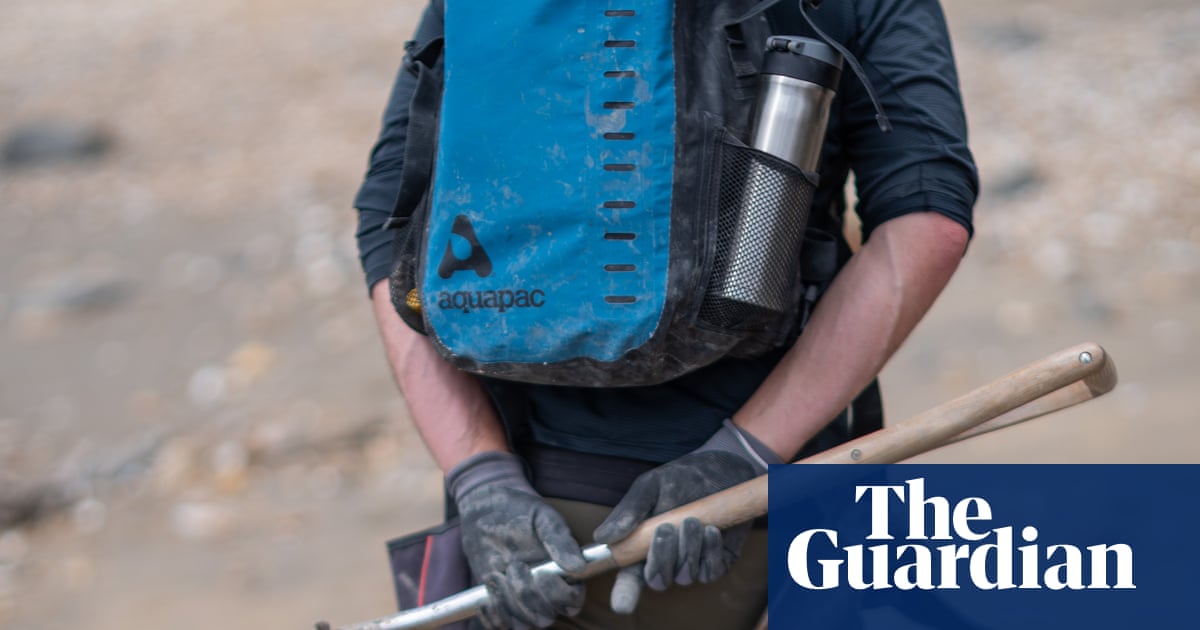
Finding a fossil is only the first step on the road to a sale: as the NHM in London notes, painstaking mechanical and chemical preparation is needed to turn it one into a museum-grade exhibit. Only dedicated fossil hunters have the tools and skills to prepare fossils – and Moore is among them.
Many experts support the status quo for fossil collecting and sales, arguing that a ban on collecting would mean many important specimens would remain undiscovered and could result in a black-market for fossils – rather than allowing collectors to work with academics.
There is no suggestion the sale of the Moore collection to the Natural History Museum Abu Dhabi has broken any rules.
Yet Dr Erin Maxwell, an expert in Early Jurassic marine vertebrates based at the State Museum of Natural History in Stuttgart said the sale was a blow. “Such a sale in my opinion represents a loss to the UK, as fossils represent part of the natural [or] cultural heritage of the region and country from which they originate.
“The loss is somewhat offset by the fact that these fossils are going to a museum rather than into the collection of a wealthy individual.”
Maxwell added that there were other options for countries such as the UK where fossils are not automatically considered property of the state.
“I think it is important for the state to have the right of first refusal on acquiring the collection on an at-cost basis prior to export – rather than the currently grossly inflated market price,” she said. “However, if the state declines, then sale to a foreign museum is a best-case scenario.”
Phil Davidson, a palaeontologist at Charmouth Heritage Coast Centre in Dorset, said the priority was that fossil specimens of key scientific interest were in public collections, such as museums, so they could be described by teams of international experts, noting most scientific journals did not allow specimens to be described if they were within a private collection.
“All the researchers I have talked to have said the same thing: the location of where the museum collection is housed is secondary,” Davidson said.
“Countless specimens of scientific importance are housed outside their country of origin. Often this was because the specific researchers are based in other countries, or that they do not have the capacity or need to focus on other pressing priorities”.
Davidson also stressed the importance of keeping the Moore collection together, adding the specimens come from a world heritage site “and this heritage is for everyone and not limited to lines on a map”.








![[seagull] review – silence proves golden in innovative if puzzling shot at Chekhov](https://i.guim.co.uk/img/media/a24223b73f2f7fcf7ea7b4f5b4f001f968cd3eb9/153_281_3293_2634/master/3293.jpg?width=1200&height=630&quality=85&auto=format&fit=crop&precrop=40:21,offset-x50,offset-y0&overlay-align=bottom%2Cleft&overlay-width=100p&overlay-base64=L2ltZy9zdGF0aWMvb3ZlcmxheXMvdGctcmV2aWV3LTMucG5n&enable=upscale&s=a3d221f69bffd24b83d26e9be3f1c934)